The Right Dose for an 18g Basket: It Is All About Headspace
For a standard 18g basket, dose 18 grams of coffee as your default — but the basket actually runs well anywhere from roughly 16.5 to 19 grams, and the number stamped on it is a guideline, not a law. What you’re really managing isn’t a magic figure; it’s headspace: the gap between the top of the tamped puck and the shower screen. Get the headspace right and the basket performs; overfill it and you choke the shot and invite channeling. So “what dose for an 18g basket” is really the question “how much coffee gives this basket the right headspace with my beans and my grind.”
I run a 0.1-gram scale under every dose precisely so I can hold this constant. Once your dose is fixed and repeatable, the grinder becomes the only variable you adjust — which is the whole basis of a sane dial-in routine. A wandering dose makes everything downstream of it guesswork.
What the “18g” on the basket actually means
Basket sizes describe a nominal dose the manufacturer designed the basket’s volume around — an 18g basket is shaped to hold and properly extract roughly 18 grams of ground coffee with sensible headspace. It’s a target the basket was built for, not a hard limit. Coffee varies in density (light roasts are denser, darker roasts puff up more), and different beans at the same weight take up different volume, so the right dose for your basket on a given bag might be a gram either side of the printed number. The basket’s tolerance is your room to move.
Headspace: the thing you’re really setting
Headspace is the small air gap above the tamped puck. You want enough that the wet, swelling puck doesn’t slam into the shower screen, but not so much that the puck floats and water finds easy channels around the edges. The classic test: pull a shot, then look at the top of the spent puck. A clean imprint of the shower screen with a thin, even kiss mark means your headspace is about right. A deep crater means too little coffee (too much headspace, puck moved around). A puck mashed flat against the screen with the screen-bolt fully embossed means too much coffee — choked headspace, and a prime cause of channeling.
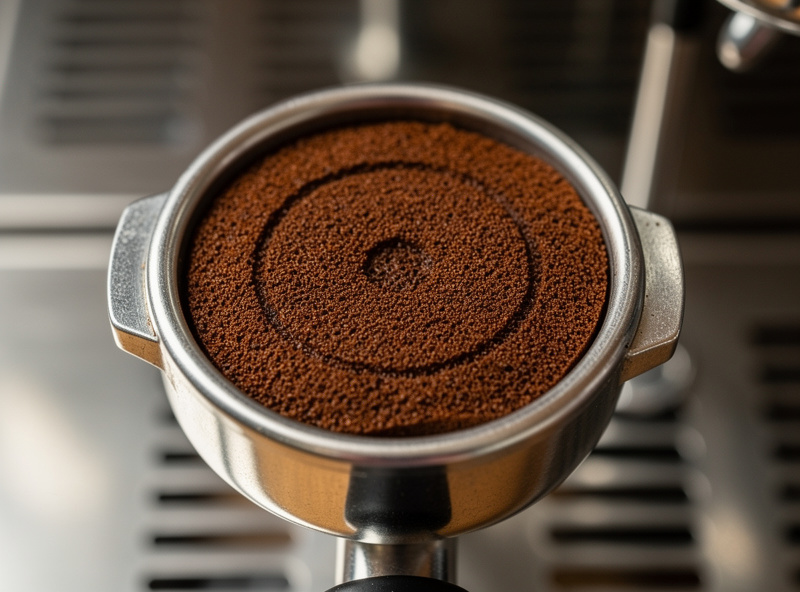
A practical dose map for an 18g basket
Here’s how I think about the usable dose range and what each end does. All of this assumes you re-dial the grind whenever you change the dose, because dose and grind are linked — more coffee in the same basket needs a slightly coarser grind to keep flow sane.
| Dose in 18g basket | Headspace | Behaviour | Use when |
|---|---|---|---|
| 16.5–17 g | Generous | Forgiving, easy flow; can feel slightly thin | Light roasts that puff, or if you’re choking shots |
| 18 g (default) | Ideal | Balanced body and headspace; the safe starting point | Almost any medium roast — start here |
| 18.5–19 g | Tight | More body and intensity; less margin for error | Dense beans, or chasing a richer cup once dialed |
| 20 g+ | Too little (overfilled) | Puck hits screen, channeling risk rises sharply | Avoid — get a 21g/22g basket instead |
The honest summary: start at 18, and only move if a clear reason pushes you. Most people who think they need to “updose” are really fighting a grind or prep problem, not a dose problem.
Dose and ratio are joined at the hip
Your dose sets the denominator of your brew ratio. At a 1:2 ratio, an 18g dose targets 36g out; a 17g dose targets 34g; a 19g dose targets 38g. Change the dose and your target yield moves with it if you want to hold the ratio. This is why I fix the dose first and leave it alone — it keeps the ratio math clean. If you’re unclear on how dose, yield and ratio interlock, the ratio breakdown is the piece to read alongside this one. Changing dose and grind and ratio all at once is the fastest way to learn nothing from three wasted shots.
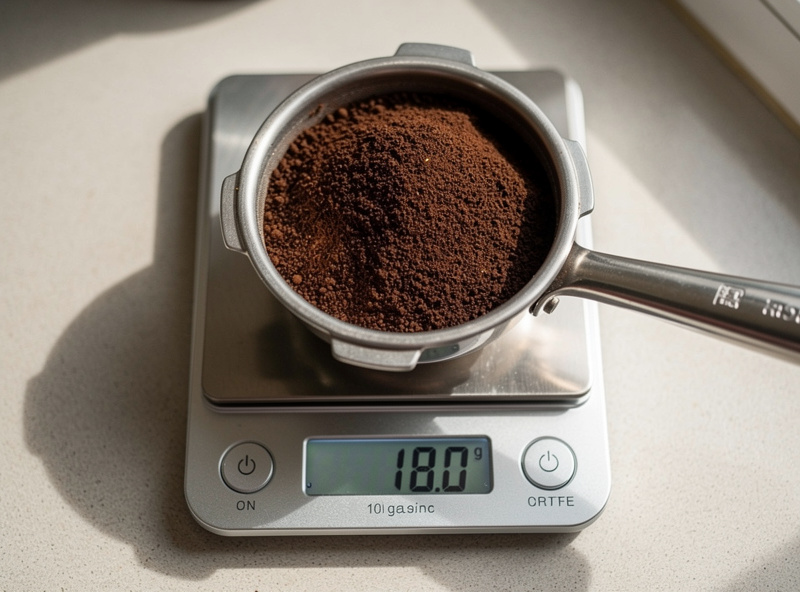
Weighing in: dose the dry grounds, not the beans (mostly)
There are two ways to hit your dose, and they matter because grinders retain coffee. Weighing whole beans before grinding (dosing by the bean) is convenient but imprecise — grinders hold back a little coffee from the last grind (retention) and give a little back, so 18g of beans in doesn’t reliably mean 18g of grounds out. The precise method is single-dosing: weigh exactly the beans you’ll grind, grind them all, and weigh the grounds in the basket to confirm you landed on target. On a low-retention single-dose grinder, in and out track closely; on a high-retention hopper grinder, expect the grounds to differ from the beans by up to a gram or so. If your shots feel inconsistent despite a fixed bean weight, retention is likely the gremlin — weigh the grounds, not just the beans. Whether upgrading to a low-retention single-dose grinder actually solves that problem for your workflow is a separate question; the single-dose grinder guide runs the real numbers on what you gain and what you give up.
Why a consistent dose makes distribution easier
There’s a quiet payoff to nailing the same dose every time that people miss: it makes your puck prep repeatable. If the dose wanders, the bed depth changes shot to shot, so the distribution and tamp that worked yesterday leave a slightly different puck today — and you end up re-learning prep on every shot. Lock the dose and the bed depth is constant, which means your WDT routine and tamp produce the same puck every single time. That consistency is what lets the grinder be the only variable you touch when you dial.
It also changes how level matters. With a consistent dose you can see, by eye and by the spent-puck imprint, whether your tamp was level — because the reference is the same every time. A wandering dose hides tamp errors inside changing bed depths. This is the unglamorous reason I weigh to a tenth of a gram: not because 0.1g of coffee changes the taste detectably on its own, but because a fixed dose removes a whole variable from every other part of the routine, so the things that do matter — grind and distribution — become readable.
When to size up the basket instead of the dose
If you genuinely want a bigger, more intense double — say you keep wanting 20+ grams — don’t cram it into an 18g basket. Buy a basket built for it. A 21g or 22g basket gives that larger dose the headspace it needs, where forcing it into an 18g basket just causes the puck to hit the screen and channel. Matching basket to intended dose is cleaner than fighting physics. Likewise, if you only ever want single shots, a proper single basket beats half-filling a double. The basket is cheap; the frustration of a chronically choked, channeling shot is not. A small set of precision baskets in a few sizes lets you match the basket to the dose you actually want.
The gear that makes dosing repeatable
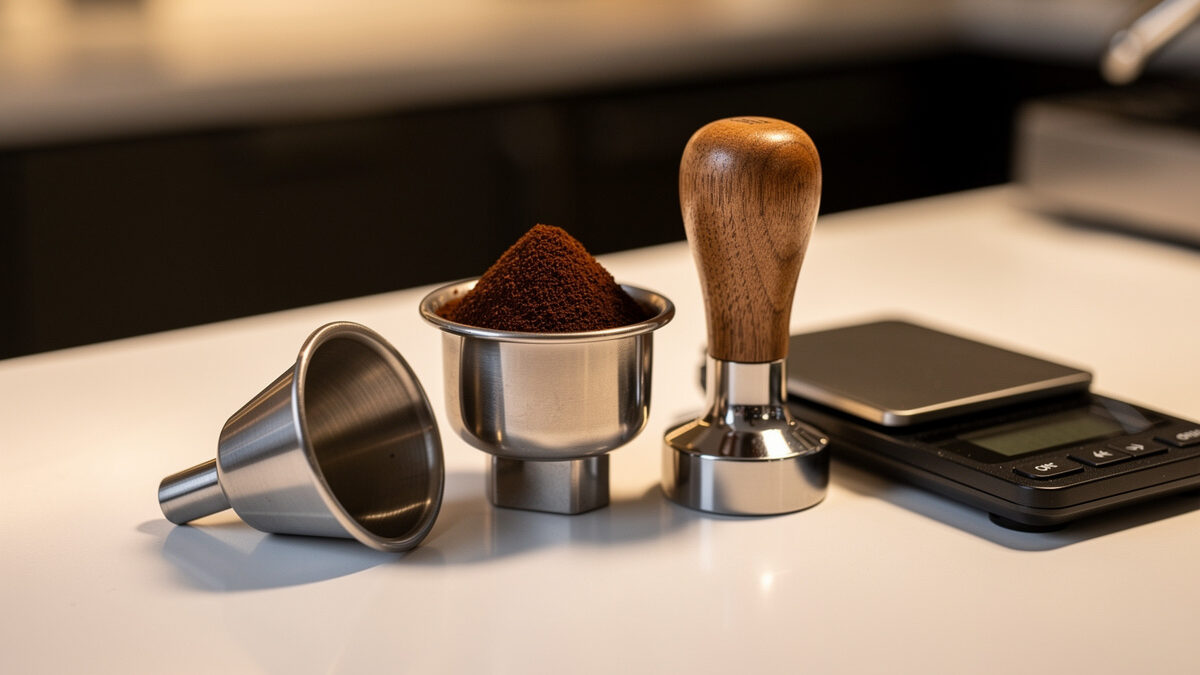
Two inexpensive tools turn dosing from guesswork into a number you hit every time. A 0.1-gram scale is non-negotiable — you can’t hold a dose you don’t measure, and tenths matter when a gram changes the ratio. A dosing funnel that sits on the basket rim keeps the weighed grounds from spilling off the edge so the dose you measured is the dose that ends up in the puck. Between them, your stated dose stops being aspirational and starts being real.
As an Amazon Associate I earn from qualifying purchases. These are tools on my own counter; the links cost you nothing extra.
Further reading
Once your dose is locked, the natural next step is the number it feeds: read espresso ratio explained to see how dose, yield, and grind combine, and the full dial-in method to put the whole loop together.
Frequently asked questions
How many grams of coffee for an 18g basket?
Start at 18 grams as your default. The basket realistically runs well from about 16.5 to 19 grams depending on the bean’s density and roast, so treat 18 as a guideline and adjust within that range. Above roughly 19 to 20 grams the puck starts hitting the shower screen and channeling becomes likely.
Is the dose printed on the basket a hard rule?
No — it’s the nominal dose the basket’s volume was designed around, not a limit. Coffee varies in density, so the right dose for proper headspace might be a gram either side of the printed number. What you’re really setting is the gap between the tamped puck and the shower screen.
What is headspace and why does it matter?
Headspace is the air gap above the tamped puck before the shower screen. Too little (overdosing) makes the swelling puck slam the screen and channel; too much (underdosing) lets the puck float and water find easy edges. The right amount leaves a clean, even shower-screen imprint on the spent puck.
Should I weigh beans or ground coffee for my dose?
Weigh the ground coffee in the basket for precision. Grinders retain and release coffee, so a weighed bean amount doesn’t reliably become the same weight of grounds. Single-dosing — weighing the exact beans, grinding them all, then confirming the grounds weight — is the accurate approach, especially on low-retention grinders.
Can I put 20 grams in an 18g basket?
It’s not advisable. At 20 grams the puck usually rises into the shower screen, leaving no headspace and sharply raising the risk of channeling and a poor extraction. If you want a 20-gram-plus dose, use a basket built for it — a 21 or 22 gram basket — rather than overfilling an 18g one.
More from This Cluster
- “Reading a Bottomless Portafilter Pour: What Your Shot Is Telling You”
- “Espresso Yield by Drink Type: Match the Shot to the Cup”
- “How Long Should an Espresso Shot Take? (Time Is a Read-Out)”
- “Espresso Shot Too Bitter? The Fix
- “Espresso Ratio Explained: Why 1:2 Is Your Default (and When to Break It)”
- “Espresso Shot Too Sour? The Fix
- “How to Dial In Espresso: Dose