Espresso Machine Maintenance: The Complete Guide
Espresso machine maintenance is a process-control problem, not a chore: keep the water clean, the group sealed, and the screens unblocked, and a machine holds nine bars and a stable brew temperature for a decade. Skip it and you are not “out of warranty,” you are tasting scale and rancid coffee oil in every shot. On my counter, the machines that have survived years of daily pulls are the boring, well-kept ones.
I run several machine classes side by side — an OPV-modded Gaggia Classic Pro, a Rancilio Silvia, an E61 heat-exchanger, and a Breville Dual Boiler — against the same beans and the same 0.1-gram scale. The maintenance habits below are the ones that actually changed what landed in the cup or kept a machine alive. This is the master guide; each section links to a deeper walkthrough where the detail earns its own page.
Why espresso machines fail (and almost all of it is preventable)
Machines rarely die from one dramatic event. They die from two slow processes: scale building inside the boiler and lines from hard water, and old coffee oil turning rancid behind the shower screen and in the three-way valve. The first chokes flow and ruins temperature stability; the second taints flavour and seizes solenoids. Both are invisible until the shot tells on them.
That is the whole game. If you control water hardness going in and stay ahead of the oil on the way out, you have eliminated the two failure modes that account for nearly every dead home machine I have torn down. Everything in this guide is a variation on those two themes — clean water in, clean group out — with a few wear parts that simply age on a predictable clock.
The espresso machine maintenance schedule at a glance
Here is the entire program on one card. Frequencies assume daily use and reasonable water; soft-water households stretch the descale interval, hard-water households shorten it. The “why” column matters more than the calendar — do the task when the shot or the machine tells you, and use the schedule as the default.
| Task | Frequency (daily use) | Why it matters | Time |
|---|---|---|---|
| Wipe group, purge, dry portafilter | Every session | Stops oil baking onto the screen and basket | 1 min |
| Water-flush the group, empty drip tray | Daily | Clears grounds before they sour | 2 min |
| Backflush with detergent | Weekly | Strips oil from the three-way valve and screen | 5 min |
| Remove and scrub the shower screen | Monthly | Restores even water distribution over the puck | 10 min |
| Descale the boiler and lines | 1–3 months by water hardness | Prevents flow loss and temperature drift | 30 min |
| Replace the group gasket | Every 9–18 months | Restores a clean seal and full lock-in | 15 min |
| Replace the shower screen | Yearly, or when pitted | Even dispersion; no permanent staining | 5 min |
If you only adopt one new habit from this entire guide, make it the weekly detergent backflush on any machine with a three-way solenoid valve (most pump machines with an E61 or a Gaggia-style group). It is the single highest-return five minutes in espresso maintenance.
Per-shot and daily habits that do most of the work
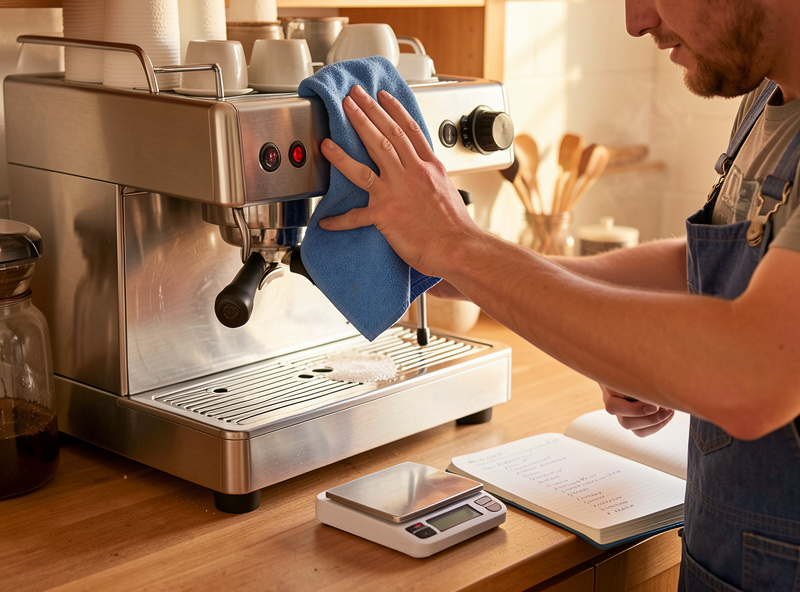
The cheapest maintenance is the stuff you do without thinking. After every shot I knock the puck, wipe the group screen with a damp cloth, and run a one-second flush of water through the empty group to rinse grounds off the screen. That single wipe is why my screens go a full month between deep cleans instead of clogging in a week.
Daily, I empty and rinse the drip tray and the drainage box — a forgotten tray is where mould and that sour, swampy smell start. I leave the portafilter out of the group when the machine is off; parking a hot portafilter in the group cooks the gasket and shortens its life. None of this takes real time, and it is the difference between a machine that ages gracefully and one that needs rescuing. If your pours have started spraying sideways despite good technique, that is usually a screen or distribution problem, not your tamp — I cover that in how to diagnose and fix channeling.
Weekly: backflushing to strip the oil
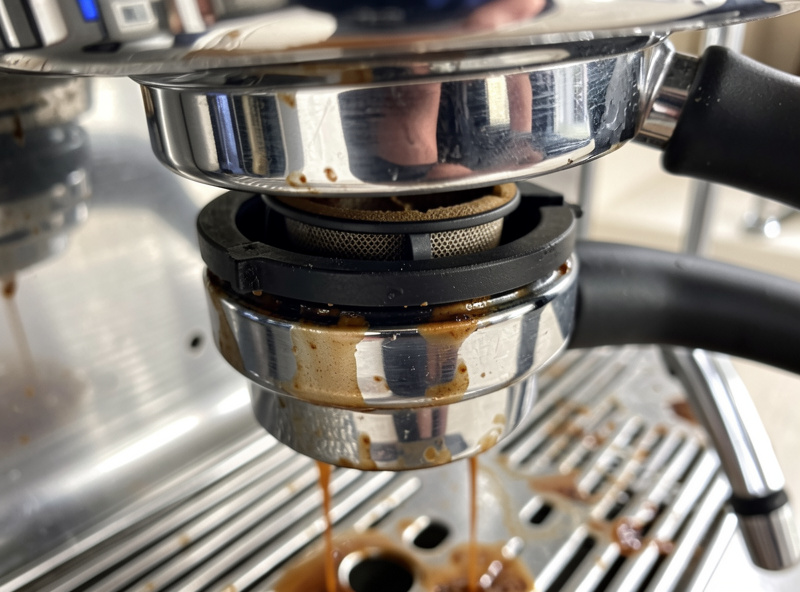
Backflushing forces water (and, periodically, detergent) backward through the group and out the three-way valve, scrubbing away the coffee oil that a normal shot never clears. On my E61 and the Gaggia, a weekly detergent backflush is non-negotiable — you can watch the rinse water run from coffee-brown to clear, and that brown is exactly what was souring your shots. A plain-water backflush after busy days, detergent once a week, is my standing rhythm.
The one rule people get wrong: single-boiler machines without a three-way solenoid valve (and most thermoblock entry machines) cannot be detergent-backflushed usefully — the water has nowhere to drain backward, so you just pressurise the group. Know your valve before you start. The full method, the detergent dose, and the machine-by-machine “can I backflush this?” answer live in the backflushing schedule and method guide.
Monthly: the shower screen and dispersion block
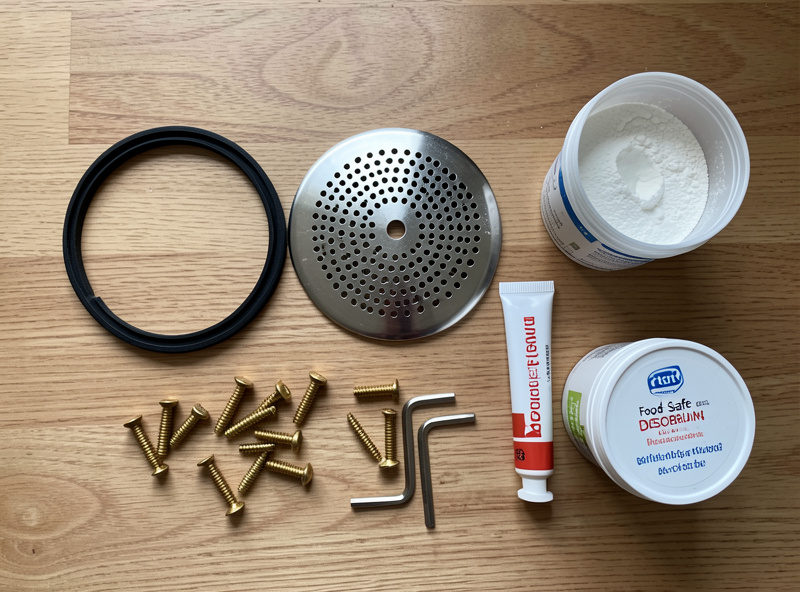
The shower screen is the perforated disc the water passes through before it hits your puck. Clog half its holes with baked oil and the water cheats toward the open ones — instant channeling no amount of puck prep will fix. Once a month I unscrew the screen, drop it in a backflush-detergent solution for fifteen minutes, scrub it with a brush, and check the dispersion block behind it. A clean screen pours an even, centred stream when you run water through the bare group.
If your screen is pitted, permanently stained, or the holes are wallowed out, replace it rather than fight it — they are a few kronor and a five-minute job. The full removal, soak, and inspection routine is in the shower screen cleaning guide, and the steam side gets the same treatment in the steam wand cleaning guide.
Descaling: the task your water hardness sets
Descaling dissolves the calcium and magnesium scale that hard water leaves inside the boiler, the lines, and the heating element. It is the maintenance task with the widest interval range because it is dictated entirely by your water: a soft-water household might descale twice a year, a hard-water one every six weeks. The tell is in the cup and the gauge — flow dropping off, the machine taking longer to come to temperature, or a thinner shot at the same grind.
Single-boiler machines have their own descaling quirks, mostly around getting solution through both the brew and steam paths, and that is the most common machine class for first buyers — so I wrote a dedicated single-boiler descaling walkthrough. The better long game is to stop feeding the machine hard water in the first place; the trade-offs between descaling and softening are in descaling vs water softening, the warning signs are catalogued in scale damage warning signs, and the whole water question gets the full treatment in the espresso water guide and my honest pick of the best water for espresso machines.
Descaling powder for home machines is the one consumable I keep stocked; a citric-acid descaling powder does the job without the harshness of vinegar, which I no longer use on any machine with aluminium internals. As an Amazon Associate I earn from qualifying purchases.
Wear parts: gaskets and screens age on a clock
Two parts simply wear out no matter how clean you keep things. The group gasket — the rubber ring the portafilter seals against — hardens and shrinks with heat cycles, and a tired gasket shows up as a portafilter handle that creeps further past centre, drips around the rim, or a hiss during the shot. On a daily machine I replace it every nine to eighteen months. The signs and the swap are detailed in group gasket replacement signs.
The shower screen is the other consumable; even a well-cleaned screen eventually pits and stains past saving. Keep a spare gasket and screen in the drawer — a group gasket and screen kit for your specific machine costs little and turns a dead-machine morning into a fifteen-minute fix.
Diagnosing trouble before it becomes a repair
A machine talks before it breaks, and the pump is the loudest voice in the room. A healthy vibratory pump has a steady hum under load; a sudden change to gurgling, screeching, or rhythmic stuttering usually means it is starving for water, drawing air, or fighting scale — not that the pump is dead. Reading those sounds correctly saves you from replacing a pump that was only thirsty. The full sound-by-sound diagnosis is in diagnosing espresso pump noises.
The other honest diagnostic tool is a bottomless portafilter: it shows you exactly where water is escaping the puck, which separates a maintenance problem (clogged screen, worn basket) from a technique one. I lean on it constantly — see reading a bottomless portafilter pour. And clean gear only matters if the shot is dialled in to begin with; the method is in the dial-in espresso guide.
Storage, travel, and winterizing
A machine you are about to leave idle — a winter away, a long trip, a move — needs a different routine than a daily driver. The enemy is standing water: it stagnates, breeds biofilm, and in a genuinely cold space, water left in a boiler can freeze and crack it. Before any long idle period I descale, run the boiler down, and dry the group. The complete shut-down and wake-up procedure is in storing and winterizing your espresso machine.
Maintenance by machine class
What you maintain depends on what you own. The honest version: simpler machines need less of you, but the tasks they do need are non-optional. Here is how the load differs across the classes I keep on the counter, and the trade-offs that drive a buying decision are in single boiler vs heat exchanger explained.
Single boiler (Gaggia Classic Pro, Rancilio Silvia): the lowest-maintenance class. Many lack a three-way valve, so backflushing is limited, but there is less to scale and less to seal. Descaling and screen care are the main jobs. My OPV-modded Classic has survived on exactly this minimal program — see whether the platform earns its keep in is the Gaggia Classic Pro worth it.
Heat exchanger (E61 group): the E61 group is a maintenance commitment — it has a gasket, a mushroom, and a three-way valve that all reward a weekly backflush and an occasional lube. In exchange you get a group built to be serviced for decades.
Dual boiler (Breville Dual Boiler): two boilers means two descaling paths and more plumbing, but the PID and water management often make scale buildup slower and the warnings clearer. More to maintain, but more forgiving when you do.
And the unglamorous truth across all three: the grinder needs maintenance too — burrs dull, fines build up, and a neglected grinder degrades your shot long before the machine does.
Water hardness sets your entire schedule
If there is one upstream variable that controls how often you do everything else, it is water hardness. Hard water — high in calcium and magnesium — lays down scale faster, which means more frequent descaling, faster element wear, and quicker flow loss. Soft, low-mineral water barely scales at all but can taste flat and, if it is also low in buffering minerals, can be mildly corrosive. The sweet spot most espresso people target is moderate hardness with enough bicarbonate to protect the boiler but not so much that scale runs away.
I test my supply rather than guess, because the descaling interval that follows is the single biggest swing in this whole guide: a genuinely hard supply can need descaling every six weeks, while a household running remineralised low-mineral water might go six months. That is a four-fold difference driven by one variable. The method I use to actually measure it is in hardness testing for espresso water, and if your tap is hard, fixing the input is almost always cheaper over the machine’s life than descaling it constantly. The honest cost comparison is in descaling vs water softening.
The reason this matters beyond machine longevity: scale is a thermal insulator. A scaled element and boiler wall transfer heat unevenly, which drifts your brew temperature and makes a PID work harder to hold a setpoint it can no longer reach cleanly. So “I keep the machine descaled” is not just a longevity claim — on my counter it is a repeatability claim, because a clean boiler holds temperature, and stable temperature is half of a consistent shot.
Lubricating the moving parts
This is the step most home owners skip and most service techs swear by. Rubber seals that move — the group gasket as the portafilter cams against it, the E61 cam mechanism, the piston seals on a lever — last dramatically longer with a thin film of food-safe lubricant and seize or tear without it. On my E61 heat-exchanger, a tiny amount of food-grade silicone grease on the cam and the gasket lip, done when I swap the gasket, keeps the lever movement smooth and stops the rubber from dragging itself to an early death.
The rule is restraint: food-safe lubricant only, a smear not a glob, and never petroleum grease anywhere coffee or steam will touch it. On a Gaggia-class single boiler there is little to lubricate beyond the gasket lip, which is part of why it is the lowest-maintenance class. On an E61 it is a real, if small, recurring task. Either way it costs a tube that lasts years and turns gasket replacement from a yearly nuisance into a longer-interval job.
The five maintenance mistakes I see most
After years of helping people resurrect neglected machines, the failures rhyme. First: never backflushing a three-way machine, then wondering why shots taste muddy and the solenoid clicks weakly — that is baked oil and a stiff valve. Second: descaling with vinegar on aluminium internals, which works once and corrodes slowly thereafter. Third: parking a hot portafilter in the group between shots, which cooks the gasket flat in months instead of years.
Fourth: chasing a “broken pump” sound that is actually the machine starving for water from a clogged inlet screen or a low tank — a five-minute check before a hundred-euro part, which is exactly why I wrote the pump noise diagnosis guide. Fifth: treating the grinder as maintenance-free while it quietly fills with stale fines and dulls its burrs; a neglected grinder ruins more shots than a neglected machine. The honest sequence is always the same — diagnose with the cheapest test first, fix the input before the symptom, and log what you changed so you know what worked.
The tools worth owning
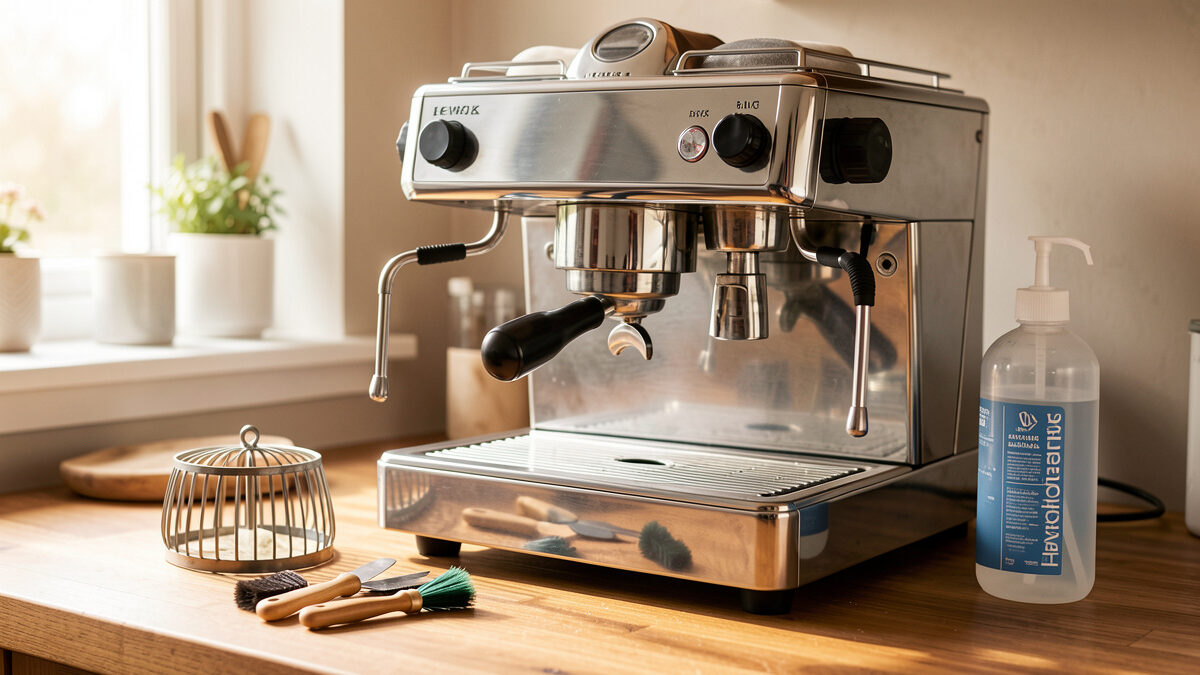
You do not need much. A backflush detergent or cleaning tablets, a blind basket (most machines ship with one), a soft group brush, a microfiber cloth, descaling powder, and a small tube of food-safe lubricant for gaskets covers ninety percent of everything in this guide. A spare gasket and screen for your specific machine round it out. That is the entire maintenance kit — cheaper than a single café habit, and it keeps a good machine pulling clean shots for years.
The throughline across every section here is the same loop I run on every bench in my workshop: change one variable, read the result, log what happened, repeat. Maintenance is just that loop applied to the machine instead of the shot. Keep the water clean, stay ahead of the oil, replace the wear parts before they fail rather than after, and the espresso machine stops being a temperamental appliance and becomes what it should be — a stable instrument that gives you the same nine bars and the same brew temperature every single morning. That repeatability is the whole point, and it is bought with minutes, not money.
Frequently Asked Questions
How often should I clean my espresso machine?
Wipe the group and purge after every shot, water-flush daily, detergent-backflush weekly, scrub the shower screen monthly, and descale every one to three months depending on water hardness. The per-shot wipe is what makes the bigger jobs quick.
Is descaling the same as backflushing?
No. Backflushing pushes detergent backward through the group to strip coffee oil from the screen and three-way valve. Descaling runs an acid solution through the boiler and lines to dissolve mineral scale from hard water. You need both; they solve different problems.
Can I use vinegar to descale my espresso machine?
You can, but I no longer do. Vinegar is harsh on aluminium internals and gaskets and leaves a smell that takes many flushes to clear. A dedicated citric-acid descaling powder is gentler and rinses cleaner for only a little more money.
How do I know if my espresso machine needs maintenance?
The shot tells you first: flow dropping at the same grind, longer warm-up, sideways spray from a bottomless portafilter, drips around the portafilter rim, or a sour off-taste. Each symptom points to a specific task, from descaling to a screen clean to a gasket swap.
Do I really need to backflush my espresso machine?
If your machine has a three-way solenoid valve, yes, weekly. The oil it removes is exactly what sours your shots and seizes the valve over time. Machines without a three-way valve cannot be detergent-backflushed and rely on descaling and screen cleaning instead.
How long should an espresso machine last with proper maintenance?
A well-maintained prosumer machine routinely runs ten to twenty years because the wear parts, like gaskets and screens, are designed to be replaced. The machines that die early almost always failed from neglected scale or rancid oil, both of which are fully preventable.