Scale Damage in Espresso Machines: The Warning Signs
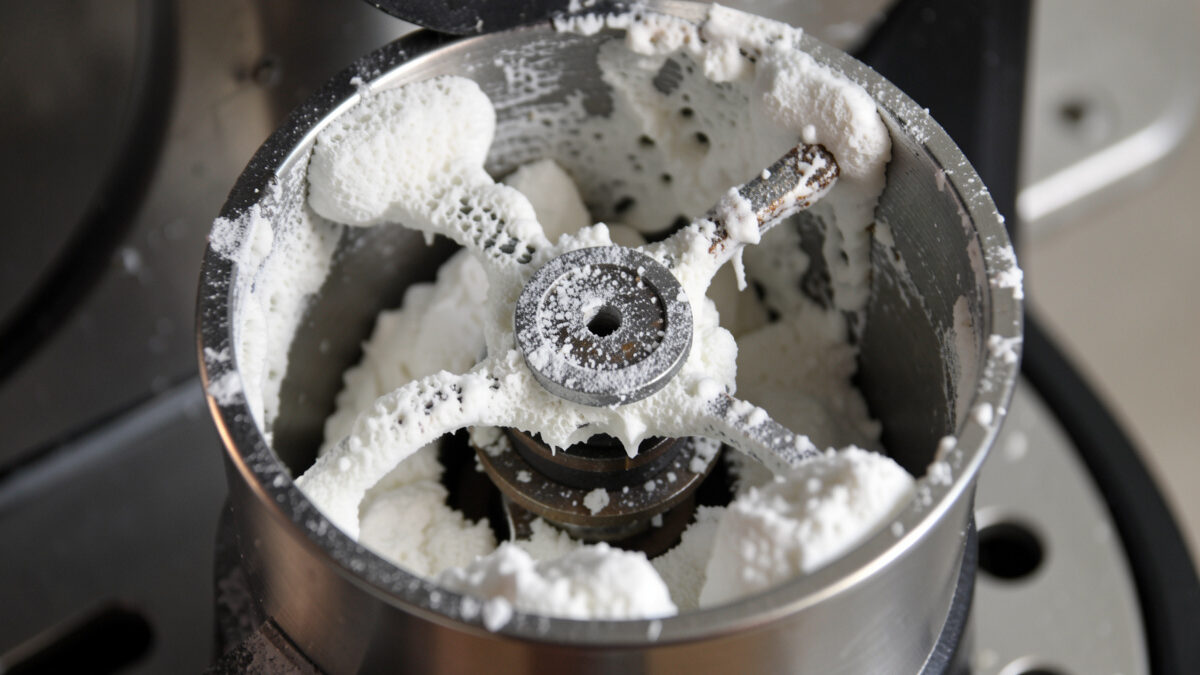
Scale rarely announces itself with a dramatic failure. It shows up first as a machine that takes longer to heat, holds temperature less steadily, and pushes water through more slowly than it used to. By the time you see white chalky crust at the group or in the tank, the deposit has already been narrowing passages and insulating the heating element for a while.
I have opened up enough machines to know the timeline, and the lesson is always the same: the early signs are subtle and the expensive ones are not. Catch scale at the “hmm, that’s slower than usual” stage and it is a routine descale; ignore it and it becomes a blocked boiler or a dead element. This is the diagnostic chapter of the broader espresso water guide — how to read the warnings before they cost you a machine.
Why Scale Damages a Machine at All
When water carrying calcium and magnesium bicarbonates is heated to brewing temperature, the bicarbonate breaks down and calcium carbonate drops out as a hard mineral crust. Inside a boiler running at 90–120°C this happens steadily, and it accumulates exactly where it does the most harm: on the heating element, inside boiler walls, and in the narrow passages and valves that control flow. Scale is a thermal insulator, so the element has to work harder and the machine loses the temperature stability you paid for. It also physically shrinks the bore of every passage it lines, which is why flow and pressure fade. None of this is visible from the outside until late, which is why you read the symptoms instead of waiting for the crust.
The Early Warning Signs
These are the ones worth catching, because at this stage a descale fixes everything. Longer heat-up time is often the first: the insulating layer on the element means the machine takes noticeably longer to reach temperature. Temperature instability follows — shots that taste inconsistent day to day, or a brew temperature that drifts, because the scaled element and boiler can no longer hold a steady set point. On my heat-exchanger, the tell is that the cooling-flush routine I run by reflex stops behaving the way muscle memory expects, because the thermosiphon passages have narrowed.
Reduced flow and weaker pressure show up as a group that pushes water more slowly, a pump that sounds like it is straining, or shots that run longer than your grind setting should produce. Slower steam recovery — the steam wand taking longer to build or rebuild pressure — points the same way. Individually these are easy to dismiss; together they are scale narrating its progress.
Reading the Symptoms
| What you notice | Likely scale cause | Stage |
|---|---|---|
| Longer heat-up time | Insulating layer on heating element | Early |
| Drifting / unstable brew temperature | Scaled element and boiler walls | Early |
| Slower flow, straining pump | Narrowed passages and valves | Mid |
| Weak or slow steam recovery | Restricted boiler and steam circuit | Mid |
| Gurgling, knocking, odd noises | Blockages disrupting flow | Mid |
| Visible white crust, leaks, off taste | Heavy deposit, stressed seals | Late |
| Element failure, blocked boiler | Advanced, sustained scaling | Damage |
The Signs That Mean You Waited Too Long
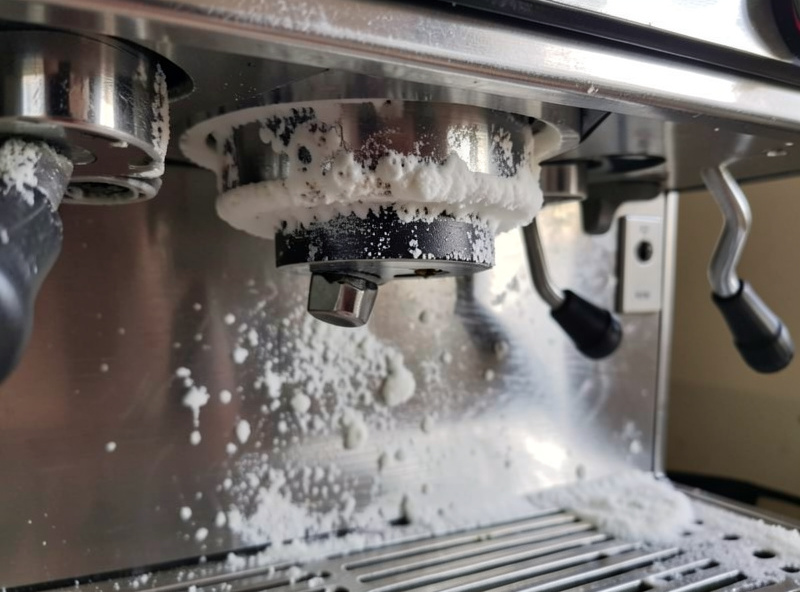
Past the early stage the symptoms get blunt. Visible deposits — white or greenish-white crust around the group head, in the water tank, or on the drip tray — mean scale is well established. Leaks appear because hardened deposit damages gaskets and seals and prevents them seating. An off taste, metallic or stale, creeps into the cup as scale and old deposit taint the water. On electronic machines you may get error codes or a machine that simply won’t reach pressure. The worst outcomes — a failed heating element, a boiler so blocked it cannot pass water, a seized valve — turn a cheap descale into a repair bill, and on a sealed dual-boiler like the Breville that can mean major service. A heat-exchanger E61’s long thermosiphon passages are similarly unforgiving once they clog. This is precisely why prevention beats cure as the machine gets more sophisticated.
How Fast Does Scale Actually Build?
There is no universal schedule, because the rate is set by two things: how hard your water is and how much you pull. On hard tap water a daily-driver machine can show early signs within weeks — I have seen heat-up times creep up in a couple of months of heavy use on untested water. On water sitting in the target band of roughly 50–70 ppm hardness with modest alkalinity, the same machine might run a year or more before it asks for attention. That spread is the whole reason I keep machines on good water: it does not stop scale, but it slows it from a monthly emergency to an occasional, predictable chore. The single biggest variable is the bicarbonate in your water — high-buffer water scales fastest — which is exactly the figure a quick test reveals, and the same hard, high-mineral water the EPA secondary standards flag for scaling and deposits. If your machine seems to scale absurdly fast, the water is the cause, not bad luck.
Where Scale Hides by Machine Class
The same deposit causes different headaches depending on the machine. On a single-boiler like my OPV-modded Gaggia Classic Pro, scale collects on an accessible element in an open boiler, so even a fairly advanced case is a straightforward descale — the forgiving end of the spectrum. A heat-exchanger E61 is harder: the long, narrow thermosiphon passages that give it its temperature stability are exactly where scale restricts flow, and clearing them takes a thorough, complete descale rather than a quick rinse. A sealed dual-boiler like the Breville is the unforgiving end — two boilers, electronics in the way, and deposit forming in places you cannot easily reach or even inspect. The pattern is consistent across every machine I run: the more sophisticated and sealed the machine, the more a scaling problem shifts from annoyance to genuine repair, and the more your water choice is really an insurance policy. The single boiler versus heat exchanger comparison digs into why the platform changes the stakes.
Catching It Before It Costs Anything
The cheapest scale damage is the kind you prevent, and prevention is mostly attention. Keep a rough mental baseline of how long your machine takes to heat and how your standard shot pours, so a drift is obvious early. Run a consistent puck prep and grind so that when a shot suddenly runs slow you can trust it is the machine, not your technique, talking. And set a descaling interval matched to your actual water rather than waiting for symptoms — a calendar reminder beats a surprise leak. None of this is exotic; it is the same instrumentation instinct of watching the read-outs and acting on small changes before they compound, applied to a boiler instead of a shot timer.
What to Do When You Spot the Signs
If you are catching early signs, descale promptly with an agent matched to your machine and flush thoroughly — that resolves the great majority of cases. But the real fix is upstream: a machine that scales fast is telling you the water is too hard or too buffered for your descaling interval. Tightening one without the other just means you will be back here in a month. So pair the descale with a look at your water hardness, and if it is high, move to a low-scale source — a known-good bottled water or a built recipe — so the deposit forms slowly enough that descaling becomes a rare, scheduled chore. That is the difference between treating symptoms forever and actually solving the problem, and it is the same change-one-variable discipline I bring to every other bench I run.
Don’t Confuse Scale With Coffee Residue
One diagnostic trap worth flagging: not every flow or taste problem is scale. Stale coffee oils and fine grounds build up in the group head, shower screen, and three-way valve, and they produce some of the same symptoms — sluggish flow, an off, rancid edge in the cup, weak-looking shots. The cure for that is backflushing with a blind basket and detergent, which is a completely different job from descaling. Descaling dissolves mineral deposit inside the boiler; backflushing clears coffee residue from the brew path. If you descale a machine whose real problem is a gummed-up shower screen, nothing improves and you blame the wrong thing. The quick way to tell them apart: residue problems usually clear with a backflush and a screen clean, while genuine scale symptoms persist until you descale and, crucially, keep coming back fast if your water is hard. When in doubt, do the cheap, harmless maintenance first — clean the screen, backflush — then judge what is left. A machine that still heats slowly and pours weak after a thorough cleaning is telling you the deposit is mineral, and the fix is descaling plus better water.
The blunt summary: scale is a slow leak of performance long before it is a visible crust. Watch heat-up time, temperature steadiness, and flow, treat any drift as an early warning, and fix the water that caused it. For the full picture of how the two halves — descaling versus softening and choosing the right water — fit together, the hub guide ties it all into one plan.